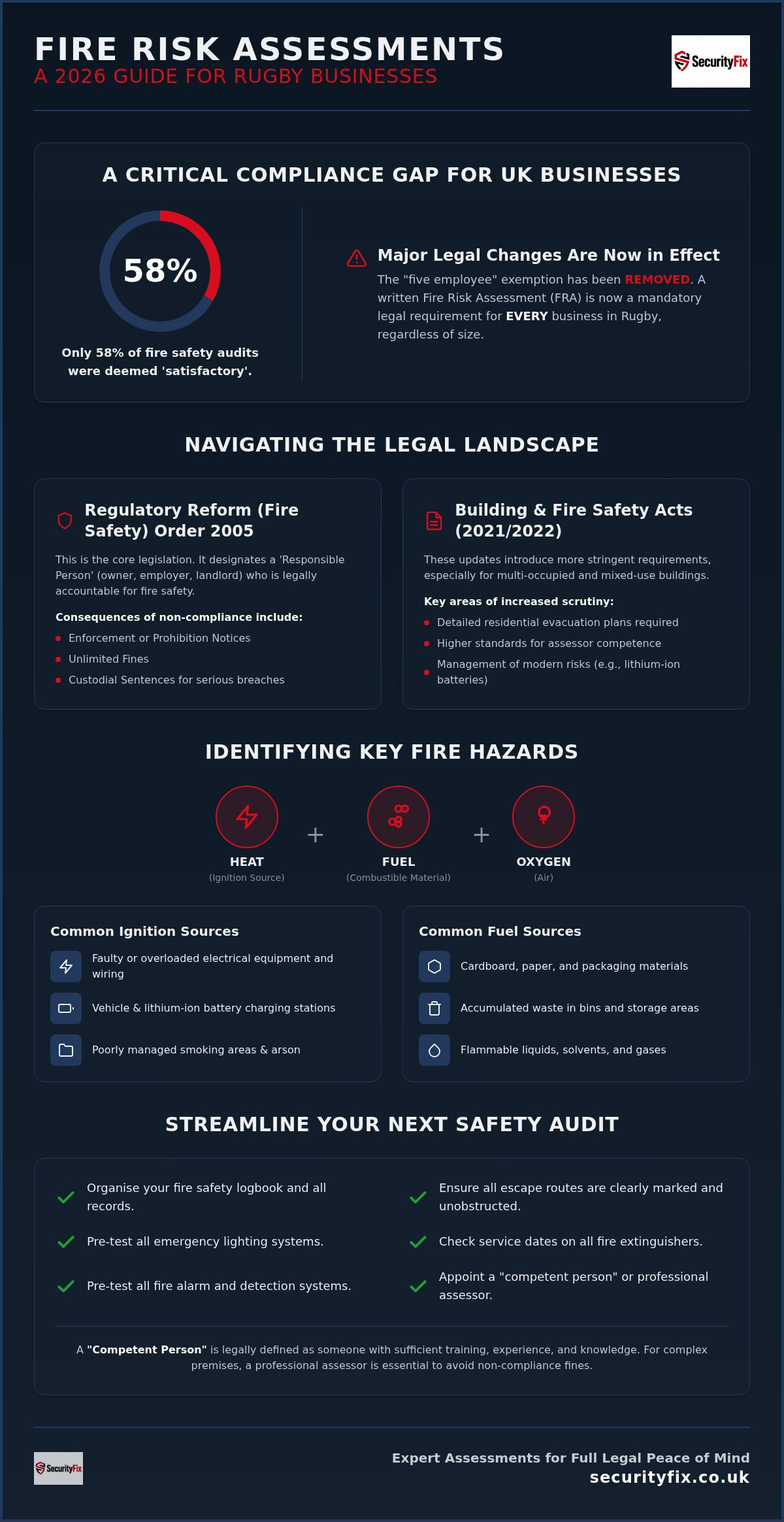
Did you know that only 58% of fire safety audits in the latest enforcement cycle were deemed satisfactory? This data reveals a significant compliance gap that leaves many businesses in Rugby vulnerable to legal action and safety risks. If you’re feeling anxious about the removal of the ‘five employee’ exemption or the stringent updates in the Building Safety Act 2022, you’re not alone. Securing a professional fire risk assessment for business premises Rugby is now a mandatory written requirement for every single business, regardless of its size.
We understand that you need a dependable partner like Security Fix to handle these complexities so you can focus on running your company. This 2026 guide serves as your authoritative roadmap to achieving full legal peace of mind and a safer environment for your staff. You’ll learn how to navigate the Regulatory Reform (Fire Safety) Order 2005 and the latest residential evacuation regulations that came into effect this April. We’ll also cover how to identify modern hazards like lithium-ion battery storage and what to look for when appointing a competent local assessor to ensure your business remains fully protected and compliant.
Key Takeaways
- Understand why every company now requires a written fire risk assessment for business premises Rugby to meet updated 2026 legal standards.
- Learn to identify common ignition sources and fuel loads within office or warehouse environments to mitigate risks proactively.
- Discover the legal definition of a “competent person” and why complex premises require professional oversight to avoid non-compliance fines.
- Streamline your next safety audit by properly organising your fire safety logbook and ensuring all emergency lighting and alarms are pre-tested.
- Find out how a local Coventry-based specialist provides a “safe pair of hands” by integrating assessments with expert hardware maintenance and support.
The Legal Necessity of Fire Risk Assessments in Rugby
A fire risk assessment (FRA) is a methodical evaluation of your building to identify potential hazards and determine the necessary safety measures to protect occupants. Under UK fire safety regulations, this process is the foundation of your property’s safety strategy. It isn’t a one-off task but a continuous obligation to ensure your premises remain safe as your business evolves. Securing a professional fire risk assessment for business premises Rugby is the only way to guarantee you meet these rigorous legal standards while protecting your investment.
The law identifies a “Responsible Person” for every commercial building. This individual is typically the employer, owner, or landlord. If you manage a retail unit in Rugby town centre or an industrial warehouse near the M6, you are legally accountable for the safety of everyone on-site. The consequences of neglecting these duties are severe. Warwickshire Fire and Rescue Service has the authority to issue enforcement or prohibition notices, which can effectively shut down your operations until safety issues are rectified. Serious breaches often lead to unlimited fines or even custodial sentences.
Regulatory Reform (Fire Safety) Order 2005
This Order is the primary piece of legislation governing fire safety in non-domestic premises across England. A significant shift occurred in October 2023 that every Rugby business owner must understand. Previously, businesses with fewer than five employees were exempt from keeping a written record of their assessment. That exemption has been removed. Now, every single business is legally required to maintain a written fire risk assessment for business premises Rugby. This ensures that even the smallest local offices or independent shops have a documented, actionable plan to manage ignition sources and escape routes.
Recent Legislative Updates for 2026
The Building Safety Act 2022 and the Fire Safety Act 2021 have introduced more stringent requirements for multi-occupied commercial buildings. As of April 6, 2026, the Fire Safety (Residential Evacuation Plans) (England) Regulations 2025 also impose new duties on those managing mixed-use premises. If your Rugby business shares a building with residential flats, you must now provide more detailed evacuation planning information. Warwickshire Fire and Rescue Service has increased its scrutiny of assessor competence; they now expect a higher level of technical detail regarding fire compartmentation and the management of modern risks like lithium-ion battery charging stations. Proactive compliance is no longer optional; it’s a vital part of modern business management.
Identifying Key Fire Hazards in Commercial Buildings
Effective hazard identification begins with a clear understanding of the fire triangle. This model illustrates that fire requires three elements to exist: heat, fuel, and oxygen. By removing or controlling any one of these components, you significantly reduce the likelihood of an incident. In the context of a fire risk assessment for business premises Rugby, this means conducting a granular walkthrough of your building to pinpoint exactly where these elements might meet. From the distribution centres near the M6 to the boutique shops in the town centre, every environment carries its own unique set of risks.
Electrical failure remains a primary cause of commercial fires across Warwickshire. In office environments, this often manifests as overloaded daisy-chained extension leads or poorly maintained portable appliances. For warehouses, the risk shifts towards fixed wiring issues, high-intensity lighting, and the charging stations for forklift batteries. The legal necessity of fire risk assessments requires that these ignition sources are not just noted but actively managed through regular testing and inspection protocols. If you’re concerned about hidden electrical risks, consulting a local fire safety specialist can help you identify vulnerabilities before they escalate.
Ignition and Fuel Source Control
Controlling fuel sources is as vital as managing ignition. Industrial units in Rugby often store flammable liquids, gases, or large volumes of combustible packaging materials. These must be stored in fire-rated cabinets or designated external areas away from the main building. Waste management is another critical factor; overflowing bins located against external walls are prime targets for arson. Ensure your smoking areas are clearly defined and equipped with non-combustible bins to prevent discarded matches or cigarettes from igniting dry waste or vegetation.
Evaluating People at Risk
A thorough assessment must consider everyone who uses the building, not just full-time employees. High-footfall retail spaces in Rugby town centre must account for the safety of customers who are unfamiliar with the layout. You must also develop Personal Emergency Evacuation Plans (PEEPs) for staff or regular visitors with mobility, visual, or hearing impairments. This ensures that when an alarm sounds, there is a pre-arranged, dignified, and safe method for their exit. Regular staff training is the final piece of the puzzle; your team must know how to identify hazards daily and react instinctively during an emergency. This proactive approach transforms your fire risk assessment for business premises Rugby from a document into a living safety culture.
Professional Assessment vs DIY: What Rugby Businesses Need to Know
The law allows a “Responsible Person” to conduct their own assessment, but it mandates that the individual must be “competent”. For a very small, single-storey shop with one exit, a basic self-assessment might suffice. However, for the vast majority of commercial properties, the complexity of modern fire safety hardware and legal documentation makes DIY a high-risk strategy. Professional assessors bring technical precision to a fire risk assessment for business premises Rugby, ensuring no detail is overlooked during the inspection process.
The Competent Person Requirement
Competence is defined by a combination of sufficient training, experience, and knowledge. For HMO landlords in Rugby, professional help is particularly critical. Multi-occupied buildings present complex escape routes and shared fire alarm systems that require expert scrutiny. A professional audit goes far beyond a basic walkthrough. It involves identifying key fire hazards within the building’s fabric, such as fire dampers, compartmentation breaches, and the specific performance of fire doors. These technical aspects are often invisible to the untrained eye but are vital for life safety.
Insurance and Liability Benefits
Insurance providers increasingly demand proof of a professional fire risk assessment for business premises Rugby before renewing policies. A DIY assessment may be rejected by an insurer following an incident, potentially leaving the business owner personally liable for damages. In contrast, a professional report acts as a legal shield. It demonstrates that you’ve taken all reasonable steps to secure the premises and have sought expert guidance to manage risk.
Professional assessors also provide a strategic roadmap for hardware improvements. They ensure your fire alarm system and emergency lighting are not just present, but appropriate for your specific risk profile. By integrating these assessments with annual maintenance contracts, businesses often find they can lower their insurance premiums. This methodical approach transforms fire safety from a stressful legal hurdle into a manageable, routine part of business operations. It provides the quiet confidence that your staff, customers, and assets are truly protected. If you operate properties across the wider Midlands region, understanding the requirements for a fire risk assessment Coventry businesses must meet can also help you benchmark your compliance standards effectively.
Preparing Your Rugby Premises for a Fire Safety Audit
Preparation transforms a stressful inspection into a smooth verification of your existing safety culture. A thorough fire risk assessment for business premises Rugby requires more than just a walkthrough; it demands a well-organised paper trail and a building that functions exactly as intended. Start by reviewing your fire safety logbook. This document is the primary evidence that you are fulfilling your legal duties as a “Responsible Person”. It is the first thing an assessor or a Warwickshire Fire and Rescue officer will ask to see during a formal visit.
Documentation and Maintenance Records
Your logbook must contain a clear, chronological history of your safety activities. This includes detailed records of fire drills, which should be conducted at least once a year, and logs of staff training sessions. You must also provide evidence that your life safety systems are being maintained by competent specialists. Ensure your PAT testing records and fixed wire electrical safety certificates are current and easily accessible. Don’t forget the service history for your fire alarm systems, emergency lighting, and CCTV. These records prove that you are proactively managing the risks identified in your previous assessments rather than just reacting to faults.
Physical Site Preparation
Conduct a pre-audit walkaround to address obvious physical failures before the professional assessor arrives. Every escape route and fire exit must be completely clear of obstructions. Even a single box stored in a corridor can lead to a non-compliance finding during a formal audit. Check your fire doors to ensure they close fully into their frames without sticking and that the intumescent seals are undamaged. Fire exit signs must be permanently fixed, clearly visible, and positioned above or adjacent to doors to indicate the direction of travel toward a place of safety.
Fire extinguishers must be serviced annually and mounted correctly on wall brackets or floor stands. Verify that they are the correct type for the specific hazards in each room, such as CO2 extinguishers placed near electrical equipment or foam extinguishers in fuel-heavy areas. If you need assistance organising your annual maintenance or want to ensure your hardware meets current standards, contact our team for professional fire safety support today. By addressing these physical and administrative details now, you demonstrate the “safe pair of hands” approach that regulators expect from Rugby business owners.
Securing Your Rugby Business with Security Fix
Security Fix provides a comprehensive safety solution for commercial properties across Warwickshire. As an independent contractor based in Coventry, we act as a “safe pair of hands” for local directors and landlords. We understand that a fire risk assessment for business premises Rugby is more than a legal hurdle; it’s a vital part of your property’s protection strategy. Our team delivers precise, actionable reports that ensure you remain fully compliant with the latest 2026 standards while maintaining a focus on practical, cost-effective solutions.
Why Choose a Local Midlands Expert?
Choosing a local specialist offers distinct advantages over national providers. We possess a deep understanding of Warwickshire building styles, from the historic structures in Rugby town centre to the modern industrial units near the M6. This local insight allows us to identify specific risks that generic assessments might overlook. Being based nearby ensures rapid response times for site visits and emergency support. You’ll have direct access to expert installers who can implement any recommended upgrades immediately, keeping your project on schedule and your premises secure.
Beyond the Assessment: Total Fire Protection
Most providers stop at the report. Security Fix bridges the gap between identifying risks and resolving them through an integrated approach. We combine our fire risk assessment for business premises Rugby with technical services like fire alarm systems installation and emergency lighting safety testing. This synergy ensures that the hardware protecting your building perfectly matches the risk profile identified in your assessment. It eliminates the confusion of dealing with multiple contractors and ensures your safety infrastructure is seamless, reliable, and professionally maintained.
We support commercial landlords and HMO managers with ongoing consultative services to maintain year-round compliance. Our annual maintenance contracts provide peace of mind by scheduling routine checks for alarms, intruder systems, and battery replacements. With 24/7 support available, you’re never left without expert guidance during a safety crisis. Ensure your Rugby business is compliant with a professional assessment from Security Fix to secure your staff, customers, and assets today.
Achieving Long-Term Fire Safety Compliance
Managing fire safety is a continuous commitment rather than a one-time task. You’ve seen how updated legislation like the Building Safety Act 2022 and the removal of the five-employee exemption have changed your obligations. A professional fire risk assessment for business premises Rugby provides the documented evidence you need to satisfy regulators and insurers alike. By identifying hazards early and maintaining a robust safety logbook, you create a culture of vigilance that protects your staff and your property.
Security Fix offers the integrated expertise needed to bridge the gap between regulatory requirements and physical safety hardware. Our local Coventry-based experts provide compliance-driven reports and full fire and security system integration. We ensure your alarms and lighting work exactly as your assessment demands. We act as your “safe pair of hands” in the Midlands, handling the technical complexities so you don’t have to. Book your professional Rugby fire risk assessment today and gain the peace of mind that comes with professional oversight. Your business is a significant investment; let us help you keep it secure and compliant for the years ahead.
Frequently Asked Questions
How often should a business fire risk assessment be reviewed in Rugby?
You should review your fire risk assessment at least once every 12 months to ensure it remains current. It’s also a legal requirement to update the document whenever significant changes occur to your building layout, staff numbers, or business activities. If you’ve recently installed new machinery or modified your escape routes, an immediate review is essential. Regular audits help Warwickshire businesses maintain continuous compliance and identify emerging hazards before they become safety risks.
Who is responsible for fire safety in a shared commercial building?
Responsibility typically falls on the “Responsible Person,” which includes employers, building owners, and occupiers. In shared Rugby premises, all parties must cooperate and coordinate their fire safety efforts. Each employer is responsible for their specific area, while the landlord usually manages communal areas like stairwells and main entrances. Clear communication between tenants is vital to ensure that a fire risk assessment for business premises Rugby covers the entire building’s safety infrastructure and evacuation protocols.
Do small businesses in Rugby really need a written fire risk assessment?
Yes, every business in the UK is now legally required to maintain a written fire risk assessment. The previous exemption for businesses with fewer than five employees was removed in October 2023. Whether you run a small retail shop or a home-based office with employees, you must document your findings and safety arrangements. This written record provides essential proof of compliance during inspections by the Warwickshire Fire and Rescue Service and is often required for insurance purposes.
What happens if my Rugby business fails a fire safety inspection?
Failing an inspection can lead to several formal actions from the fire authority. Inspectors may issue an enforcement notice requiring you to fix specific issues within a set timeframe. In high-risk scenarios, they might serve a prohibition notice, which can restrict or shut down access to your building immediately. Serious or persistent non-compliance often results in unlimited fines or criminal prosecution. Taking proactive steps to secure a professional fire risk assessment for business premises Rugby prevents these costly legal disruptions.
How long does a professional fire risk assessment take to complete?
The duration depends entirely on the size and complexity of your property. A small office or retail unit in Rugby usually takes between one and three hours for the on-site inspection. Larger industrial warehouses or multi-storey HMOs require more time to evaluate complex escape routes and fire compartmentation. Following the physical survey, your assessor will spend several hours compiling the technical report and action plan, typically delivering the final document within a few working days.
Can a landlord perform their own fire risk assessment for an HMO?
While the law allows landlords to conduct their own assessments, they must be “competent” to do so. This means having the necessary training, knowledge, and experience to identify technical fire risks. HMOs are classified as higher-risk premises due to their residential nature and shared facilities. Most landlords choose professional assessors to ensure they meet the strict standards required by local authorities. Professional oversight provides a “safe pair of hands” and protects you from personal liability if an incident occurs.
Does a fire risk assessment include testing the fire alarm system?
An assessment is primarily a strategic audit of your safety management and physical hazards rather than a technical testing service. However, the assessor will visually inspect your fire alarm panels and check your maintenance logs to verify that regular testing is occurring. While the assessment identifies if your system is adequate, you still need separate, scheduled maintenance visits. Security Fix integrates these services, ensuring your hardware is both strategically sound and functionally tested through dedicated annual maintenance contracts.
How much does a fire risk assessment for business premises in Rugby cost?
The cost of a professional assessment varies based on the size of your building, the number of occupants, and the complexity of the risks involved. A large manufacturing facility with hazardous materials will require a more detailed audit than a single-room office. Most providers offer fixed-fee quotes tailored to your specific premises. Investing in a professional report is a cost-effective way to avoid the significant financial penalties associated with non-compliance and ensures your insurance remains valid.